AI Business Systems
Active · pre-revenueAn independent AI systems studio for small businesses and founders — lead capture, follow-up, and internal dashboards built as focused workflows, not a platform. Behind the brand site sits an internal operating stack: a Command Center CRM with a quote, contract, and delivery pipeline and a cold-outreach cadence; a Prospect Finder that sources leads into it; a demo pipeline that produces personalized, click-through front-desk demos with video for local home-service and clinic prospects; and now a self-serve product, ABS Front Desk.
- AI
- Consulting
- Self-hosted
- Automation
- CRM
Updated 2026-11-02
Overview
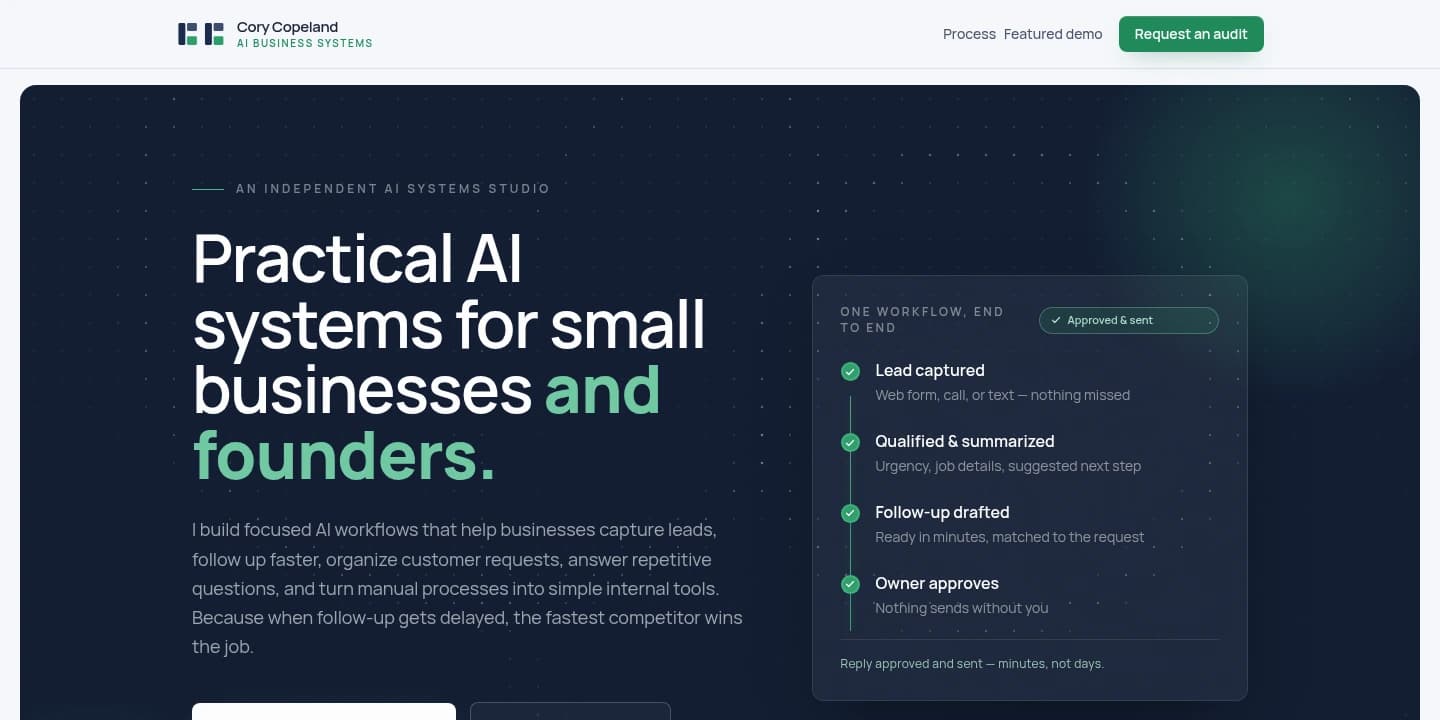
AI Business Systems is an independent AI-systems studio: practical AI workflows — lead capture, follow-up, customer support, internal dashboards — built for small businesses and solo founders who need one well-built system, not another platform to babysit. It's live at abs.corycopeland.dev.
It's also a full operating business, not just a landing page. Behind the public site sits an internal ops app with a real pricing engine, a contract generator, and a prospect-tracking CRM; a personalized outreach-video pipeline that renders and publishes real videos for real prospects; and two live, click-through demo apps that show the product instead of describing it. Every piece — positioning, product, sales tooling, and outreach — was designed, built, and is operated solo.
The studio has since narrowed its front door. Rather than selling five systems at once, the brand site now funnels to a single productized offer, an AI Front Desk for contractors and clinics. That offer is now also a self-serve product: ABS Front Desk, where an owner can sign up and get an after-hours AI phone line without a sales call.
The problem
Most small businesses lose leads and hours to the same failure mode: a web form, a call, or a text comes in, and the response is slow, generic, or just doesn't happen — because the owner is on a roof, in a treatment room, or buried in the fifth repetitive question of the day. The fastest competitor, not the best one, wins the job.
The market's answer is usually a platform: a CRM subscription, a chatbot widget, an "AI agent" that promises to run the whole business. Small operators don't want a platform. They want the one workflow that's actually bleeding them — leads, follow-up, FAQs — fixed, without months of onboarding or a black-box vendor relationship.
Audience
- Home-service businesses and contractors — roofing, HVAC, plumbing — where a missed call is a missed job.
- Local service companies, consultants, and solo founders with real customer inquiries and no dedicated ops staff to triage them.
- Owners who want to talk to the person building the system, not an account manager — the studio is explicitly founder-operated, no handoffs.
What I built
- The public studio site at abs.corycopeland.dev — positioning, a five-system offer menu (Lead Capture, Follow-Up Workflows, Customer Support Assistants, Internal Dashboards, MVP Prototypes), a four-step engagement model, and a real workflow-audit intake form.
- Two live, click-through demo apps, not screenshots: BayPoint Roofing (quote intake, urgency classification, an owner dashboard, a lead-detail view) and Luma Wellness (an FAQ-aware AI reception assistant, appointment intake, a front-desk triage view). Each demo ships with its own narrated video walkthrough.
- An internal CRM behind the demo site — password-gated, SQLite-backed, a real pipeline kanban and prospect table with CSV export and audit-lead import. Not a demo; this is the tool actually used to run outreach.
- A Command Center — a substantially larger internal ops app (1,300+ commits, past v0.30) with assisted business-profile intake (crawl, parse, AI-draft with citation grounding), a build-module/template system, a real pricing engine that quotes every module, an outreach tool that drafts emails for approve-to-send via Resend, a contract generator with a send-for-signature flow, and a delivery/handoff tracker. It runs the actual multi-stage prospect pipeline — audit sold, proposal sent, deposit paid, delivered — behind the studio's public face.
- An outreach-video pipeline that captures a demo app running in
"record mode," muxes it with a narrated intro, and publishes a
personalized video to
abs.corycopeland.dev/mediafor a specific prospect.
Built since:
- A dedicated AI Front Desk offer page, now at
absfrontdesk.com —
a contractor-facing hero, the problem framing, a Capture-vs-Triage
comparison, pricing tiers, and a personalized-demo request form as the
primary conversion. The main brand site was repointed to generalist
positioning and now funnels into it: the front-desk sections were removed
from the landing page, the nav slimmed, and the old static
/pricingsheet 301'd rather than left to rot. - Personalized prospect demos, each with video, built for local home-service and clinic businesses before the first email goes out, plus a fictional Rivergate build kept as the public portfolio piece. The renderer gained bilingual support (per-language answer buttons) for the practices that need it.
- A self-serve product, ABS Front Desk: sign-up, billing, and automatic provisioning of a phone number and voice assistant per business. The Command Center is built to take trial sign-ups back into the pipeline and end that prospect's cold-outreach cadence.
- Touch logging and a per-deal activity timeline in the Command Center, so a call or a LinkedIn message is recorded the same way an email is, and the deal page shows one merged history instead of a bare outreach button.
- Prospect Finder — a separate lead-sourcing tool that feeds the Command Center. Promoted prospects now carry industry, service area, and AI-enriched pain signals and recommended services into the deal record, refreshing on replay without blanking fields a human has since edited.
Product decisions
- Separate systems, shared workflow state — not one monolith. The
public demo site, the CRM, the Command Center, and the outreach pipeline
stay bounded, independently deployable systems linked by a shared
Opportunityrecord rather than one sprawling app. Each can change without risking the others. - A person approves every send. The site's guardrail line — "AI drafts and organizes; a person approves. No autonomous decisions" — isn't just marketing copy. It's the actual design of both the demo apps (owner approves every AI-suggested reply) and the outreach tool (approve-to-send email drafts, nothing fires automatically).
- Prove the demo before pitching the platform. The offer leads with two fully-built, live, click-through demos on real (fictional) small-business scenarios rather than a slide deck — a prospect can use the product before a sales call happens.
- Client-facing demos stay pristine; automation happens around them, not inside them. The outreach-video capture uses Playwright script injection to trigger "record mode" rather than modifying the demo HTML itself, so the same code path a prospect clicks through is exactly what gets recorded — with a hard-fail sync check (audio/video drift assertion) before anything publishes.
- Liability scope follows product tier, deliberately. The studio's two productized tiers — Capture (answer, qualify, route) vs. Triage (adds emergency dispatch decisions) — map directly to different professional liability postures, decided before either tier takes a live customer call.
- CSV first, live CRM integrations later. The CRM-audit module proves the workflow against exported data before building out live API integrations with a prospect's existing tools — the same "prove it small, then earn the complexity" discipline that shows up across every project in this portfolio.
Technical architecture
- Public demo site (
ai-business-systems-demos): Vite + React + TS + Tailwind, Docker Compose + Caddy on a self-hosted LXC, Forgejo Actions auto-deploysmain. The CRM behind it runs a small Node/Express API (audit-api) over SQLite. - Command Center (
ai-systems-builder): Next.js 16 + React 19 + TypeScript,better-sqlite3, self-hosted on a private network with no public domain for the app itself, by design, since it holds real prospect data. Only a few client-facing routes (quotes, signing, the client portal) are exposed publicly. Built TDD-first with per-PR spec and code-quality reviews. - Outreach video pipeline (
asb-outreach-demos): Playwright-driven capture (render/capture.mjs) muxed with ffmpeg (render/mux.mjs), publishing finished videos toabs.corycopeland.dev/media. - Domain: the demo site moved from
demos.corycopeland.devtoabs.corycopeland.devwith a 301 redirect for old links.
Design and brand
Founder-operated positioning, stated plainly rather than styled around: "you talk to the person who builds it," no account managers, no long contracts. The visual system is a deep-teal, dark studio palette with a single green accent — deliberately closer to a technical product site than an agency brand, matching the "practical, not platform" promise in the copy itself.
Current status
- Public site and two demo apps live and working.
- Internal Command Center is a real, actively developed tool — pricing engine, contract generator, outreach drafting, and delivery tracking are built and used, not scaffolded.
- Real outreach is underway, not just planned. Local prospects have personalized front-desk demos and videos published, and outreach drafts are gated on pitch strength: a lead is only drafted against if the audit actually found something worth saying.
- The offer is productized twice over: a done-for-you service, and the self-serve ABS Front Desk, which is built and pre-launch with billing in test mode.
- Pre-revenue. No paying client yet as of this writing. The LLC is formed. Errors-and-omissions coverage is still a gate before the first paying customer and before any emergency-triage line goes live, a deliberate constraint, not an oversight.
What I would do next
- Convert the in-pipeline prospects into paid workflow audits — the low-risk advisory entry point ahead of live implementation work.
- Close the loop from demo to reply. The pipeline has a lot of top-of-funnel and no signed pilot yet. The next real question is whether the demos are landing, not whether more can be built.
- Bind E&O coverage, then switch ABS Front Desk billing to live.
Proof
- Live site: abs.corycopeland.dev
- Live demos: BayPoint Roofing, Luma Wellness
- The hero image on this page is a live capture of the studio site.