GrindOS
Pre-launch · invite-only early accessA workout logging and programming app that keeps strength sets, scored metcons, cardio, and mobility in one training history. Every block, workout, day, and program is a clonable node, so programs copy and repeat at any level, and the results ledger is append-only — a correction supersedes a set rather than overwriting it. Imports PDF plans and TrainingPeaks CSVs, schedules around your calendar, logs offline, and carries an XP, level, and badge progression system. The iOS app is in App Store review; the web app is invite-only behind a public waitlist.
- Fitness
- Expo
- React Native
- Supabase
- Offline-first
- Self-hosted
Updated 2026-11-02
Overview
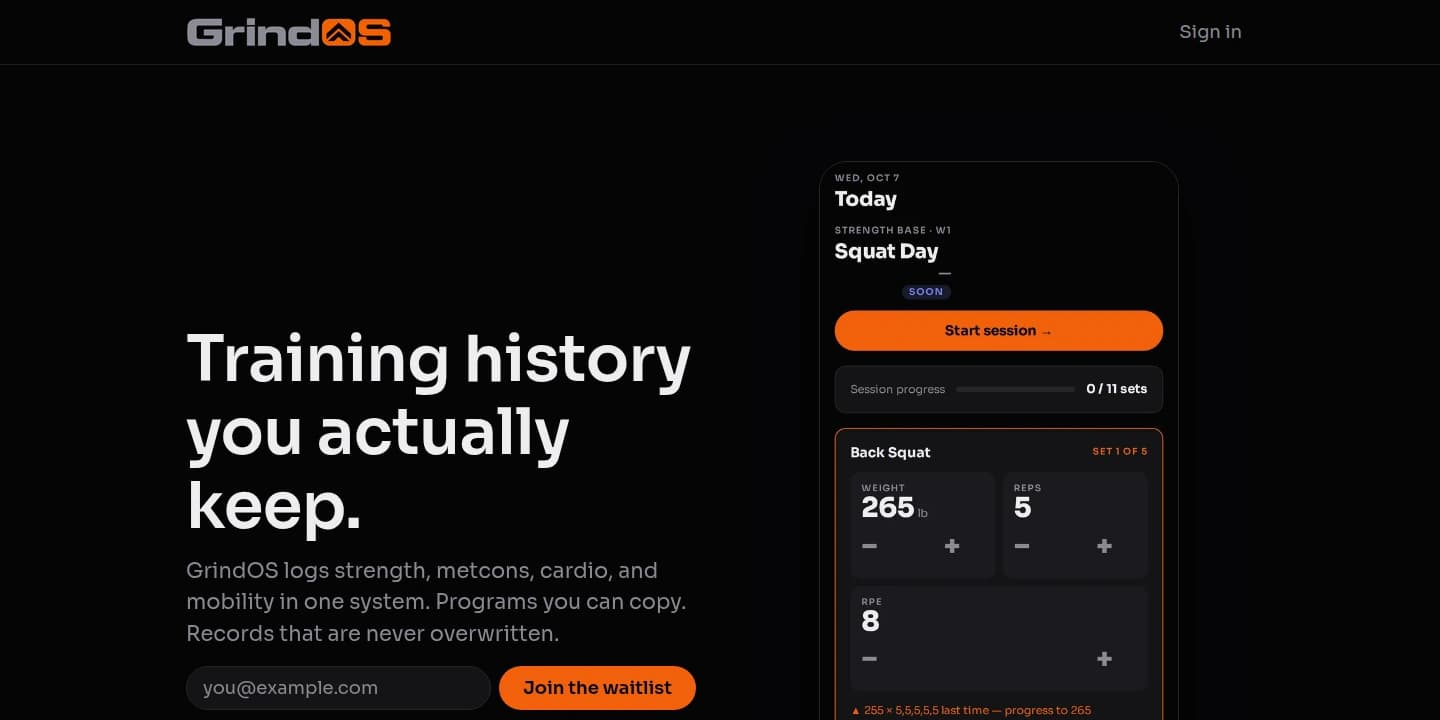
GrindOS is a workout logging and programming app. It keeps strength sets, scored metcons (for time, AMRAP, max load), cardio and mobility in one training history. It started as a tool I wanted for my own training and is becoming a product: the iOS app is in App Store review, and the web app is open by invitation from the waitlist at grindos.fit.
Two ideas carry the design. First, everything is a clonable node: a block, a workout, a day and a whole program all copy and paste the same way. Second, history is append-only, so a logged set is never overwritten. A correction adds a new row that supersedes the old one.
The problem
People who train seriously across disciplines usually split their history across tools. Lifts go in one app, metcon scores in another, runs in a third, and mobility nowhere. Programs from coaches arrive as PDFs or exports that have to be retyped. Most logging apps also let history be edited in place, which quietly undermines the thing a training log exists for: an honest record of what you actually did.
Audience
- People who log their own training across strength, conditioning, cardio and mobility, and want one history instead of three apps.
- People who follow external programs and want to bring them in rather than retype them.
What I built
- A clonable program tree: block, workout, day and program are all the same kind of node. Copy and paste works at every level. Programs are day-numbered templates mapped onto the calendar when you start them, and they can be repeated.
- Logging with personal records: PRs are derived from the history, never stored as editable values. Trend charts show progress over time.
- Importers: PDF workout plans (parsed in the browser), TrainingPeaks CSV
exports, and calendar
.icsfiles for busy times. Every importer shows what it found and what it couldn't read, and writes nothing until you confirm. The calendar importer reads start and end times only, so event titles never leave the page. - A scheduler that plans sessions around your availability, flags training-load conflicts, and eases a session when readiness is low.
- Offline logging: sets queue on the device and sync later, carrying the time they were actually performed rather than the time they synced.
- A progression system: XP, levels, ranks and badges, with the XP ledger kept on the server. Your level is driven by effective XP, which weights recent training more heavily and decays gently if you stop. Lifetime XP is a separate running total that never decays.
- Program sharing: publish a program and let someone clone it from a share link.
- Apple Health ingest, plus iOS extras: a Live Activity on the lock screen and Dynamic Island during a workout, and a spoken rest timer.
- A marketing site at grindos.fit with a waitlist, bot protection, and confirmation email. A live widget on the page lets you log a set and try to change it.
Product decisions
- Append-only history. The database has no update or delete policies for results. A correction supersedes a row instead of rewriting it. This makes the log trustworthy and makes PRs reproducible.
- One tree, one clone engine. Building copy and paste once, for every level, made programs and repeats fall out for free.
- Importers preview before they write. A misread PDF should cost a glance, not a cleanup.
- Invite-only while it matures. Public sign-up is off. New users come in from the waitlist.
- Route data is never stored. It is a deliberate privacy line, recorded in the schema.
Technical approach
- App: a single Expo universal app (iOS, Android and web) with Expo Router, React Native, TypeScript and NativeWind.
- Backend: self-hosted Supabase (Postgres, auth, row-level security), with schema changes in numbered migrations.
- Web: a static export served from a container behind Cloudflare Tunnel.
- Marketing site: Astro on Cloudflare Pages, with the waitlist in
Cloudflare D1. It deploys automatically on every push to
main. - Error tracking: self-hosted.
Testing and safety
The test suite is large: unit tests for the pure logic, SQL assertions for row-level security, and Playwright end-to-end tests that include accessibility, wide-layout and keyboard checks.
Test isolation from production is strict. Database and end-to-end tests run only against a separate test stack. The environment loader fails closed if it sees a production host. Playwright aborts any request to production, and the web bundle is scanned for production hostnames before tests run. Every migration is proven on the test stack before it touches production.
The offline queue is a pure reducer with no React Native or Supabase imports, so it can be tested exhaustively in Node.
Current status
- iOS app: in App Store review.
- Web app: invite-only early access. The waitlist is open at grindos.fit.
- Free during early access. Pricing comes later.
What comes next
- Live GPS runs with route maps (routes still won't be stored).
- A daily workout briefing: movement explainers, positioning cues and a readiness-based call to go harder or easier.
- Form guidance for each movement, toggleable in workouts and in the movement library.
- Opening sign-ups beyond the waitlist.