ABS Front Desk
Pre-launch · billing in test modeA self-serve AI phone line for home-service businesses. An owner signs up, picks a plan, enters their company details, and gets an after-hours line that answers in the business's name, captures the caller's details, flags emergencies, and texts the owner — with no operator in the loop. Provisioning, metered usage billing, dunning, and a tenant dashboard are built; an end-to-end go-live run with real calls passed in test mode.
- AI voice
- SaaS
- Multi-tenant
- Next.js
- Stripe
- Self-hosted
Updated 2026-11-02
Overview
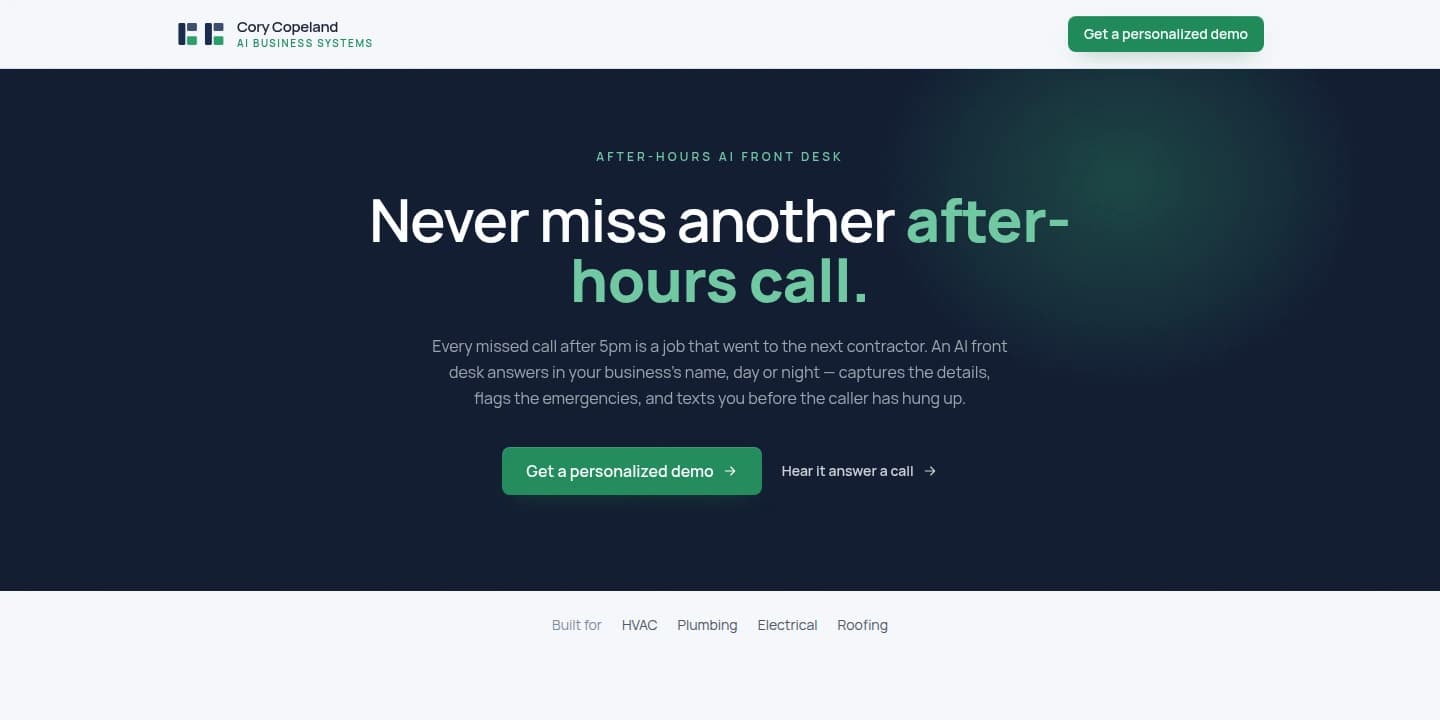
ABS Front Desk is a self-serve AI phone line for home-service businesses. An owner signs up, picks a plan, enters their company details, and gets an after-hours line. It answers in the business's name and captures the caller's name, callback number, address and problem. It flags emergencies and texts the owner before the caller has hung up. No operator is in the loop at any step.
It is the self-serve version of the AI Front Desk offer from AI Business Systems. The public site is absfrontdesk.com. The product is built and deployed, and is pre-launch: billing still runs in Stripe test mode.
The problem
For a plumber, an electrician or an HVAC company, a missed call after 5pm is often a job that went to the next contractor. Voicemail tends to lose the caller. AI phone setups are usually sold through a sales call and configured by hand, which doesn't fit a two-truck business that wants it working tonight.
Audience
- Home-service businesses: HVAC, plumbing, electrical and roofing companies where after-hours calls are real revenue.
- Owners who want to set it up themselves, without a sales call or an agency in the middle.
What I built
- Self-serve onboarding: sign-up, terms acceptance, bot protection, and Stripe checkout. A setup wizard ends with real go-live provisioning: a phone number and a voice assistant created for that business.
- Two plans: Capture answers, qualifies and texts the owner. Triage adds emergency triage and on-call texts. Both have included minutes, metered overage and a short trial.
- A tenant dashboard: calls, usage against the plan, settings and help.
- Billing that survives the edge cases: deferred downgrades, dunning, and suspension on non-payment. A final overage bill on cancel-now, and automatic cancellation of duplicate subscriptions.
- An operator console: feature flags, a daily digest, and alerts on refunds, disputes and unusual usage.
- Observability: a deep health check, error emails, and scheduled probes.
- Funnel tracking built to report back to the sales pipeline, so the internal Command Center can tell when a prospect has started a trial.
Product decisions
- Safety lives in the server, not the prompt. The 911 line and the call recording disclosure can't be edited by the tenant. Before any assistant is created, the server checks that both are present. Texts go only to verified contacts, and premium-rate and international numbers are never texted.
- Liability follows the plan. Capture makes no triage or dispatch decisions. Triage, which does, stays switched off until the matching insurance is in place.
- Treat everything the caller says as untrusted. Prompt content is handled as hostile input, with adversarial tests to match.
- Keep less. Call audio isn't kept, and transcripts are deleted on a fixed schedule.
Technical approach
- Stack: Next.js (App Router), React, TypeScript and Tailwind. A self-hosted Postgres with plain SQL migrations sits behind it.
- Vendors: Stripe for billing, Vapi for voice, Twilio for numbers and SMS, and Resend for email. Each vendor sits behind its own interface with a fake implementation, and business logic never imports a vendor SDK directly.
- Tenant isolation: every tenant row carries an organization id, and tenant reads run under database row-level security. The tests run the same SQL against an in-process Postgres, so the policies themselves are tested, hostile cases included.
- The call pipeline:
- Each business gets one voice assistant, built from a versioned template for its plan.
- A single webhook authenticates every call by line secret and assistant id. An unknown line gets the same answer as a wrong secret, so organization ids can't be enumerated.
- The end-of-call report is idempotent. A caller who hangs up early is still metered exactly once.
- Calls answered while the app was down are recovered afterward, and a failed tool result is never read aloud to the caller.
- Usage billing: a ledger with idempotency keys, plus a daily sweep that re-posts any metering event that didn't land.
- Hosting: Docker on self-hosted infrastructure behind Cloudflare Tunnel. A Postgres-backed job queue is drained on a timer. The database and auth services expose no public routes.
Current status
- Built and deployed. A test-mode go-live run passed end to end. It provisioned a real number and a real assistant. Real calls from an outside phone got the greeting and disclosure, the owner got the text, and the call landed on the dashboard and was metered.
- Pre-launch. Billing is in Stripe test mode, and no paying customers yet.
- Gated on insurance: errors-and-omissions coverage before the first paying customer, and Triage stays off until its coverage is bound.
What comes next
- Bind coverage, switch Stripe to live, and take the first paying customer.
- Turn on Triage once its coverage is in place.
- Learn from real calls which details owners actually act on, and tune the capture flow to match.